A symptom table compresses a complicated history into a small space. That compression is useful: readers can see the measured categories and examine their denominators. It also removes information. A bar cannot tell you which reports belong together, when a particular experience began, or whether an unanswered question later reached the right person. Understanding that loss of detail is part of interpreting evidence, not an objection to using tables.
This Care Path Atlas guide uses the accompanying tirzepatide figure to examine those measurement questions. The numerical results and their study boundaries appear together below. Our interpretation follows the information from a category label to the records that would be needed for a fuller account. It then connects that scientific reading exercise with questions about a care handoff, without treating a research percentage as a measure of any provider’s responsiveness.
Reading the evidence
- Name the unit
- People, symptom categories, episodes, and messages are different units. A conclusion must use the unit its evidence actually measures.
Sources: Rubino 2025
- Check shared membership
- Separate category totals do not identify how many people belong to both categories. Addition needs information about overlap.
Sources: Rubino 2025
- Keep dates distinct
- An occurrence date, a report date, and a review date answer different questions. A category label cannot replace their chronology.
Sources: Rubino 2025
- Specify the comparison
- Comparing outcomes within an arm is different from comparing the same outcome between treatment assignments.
Sources: Rubino 2025
- Ask what survives a handoff
- A useful record preserves the meaning of an entry, its provenance, later corrections, and the unresolved question attached to it.
Sources: Rubino 2025
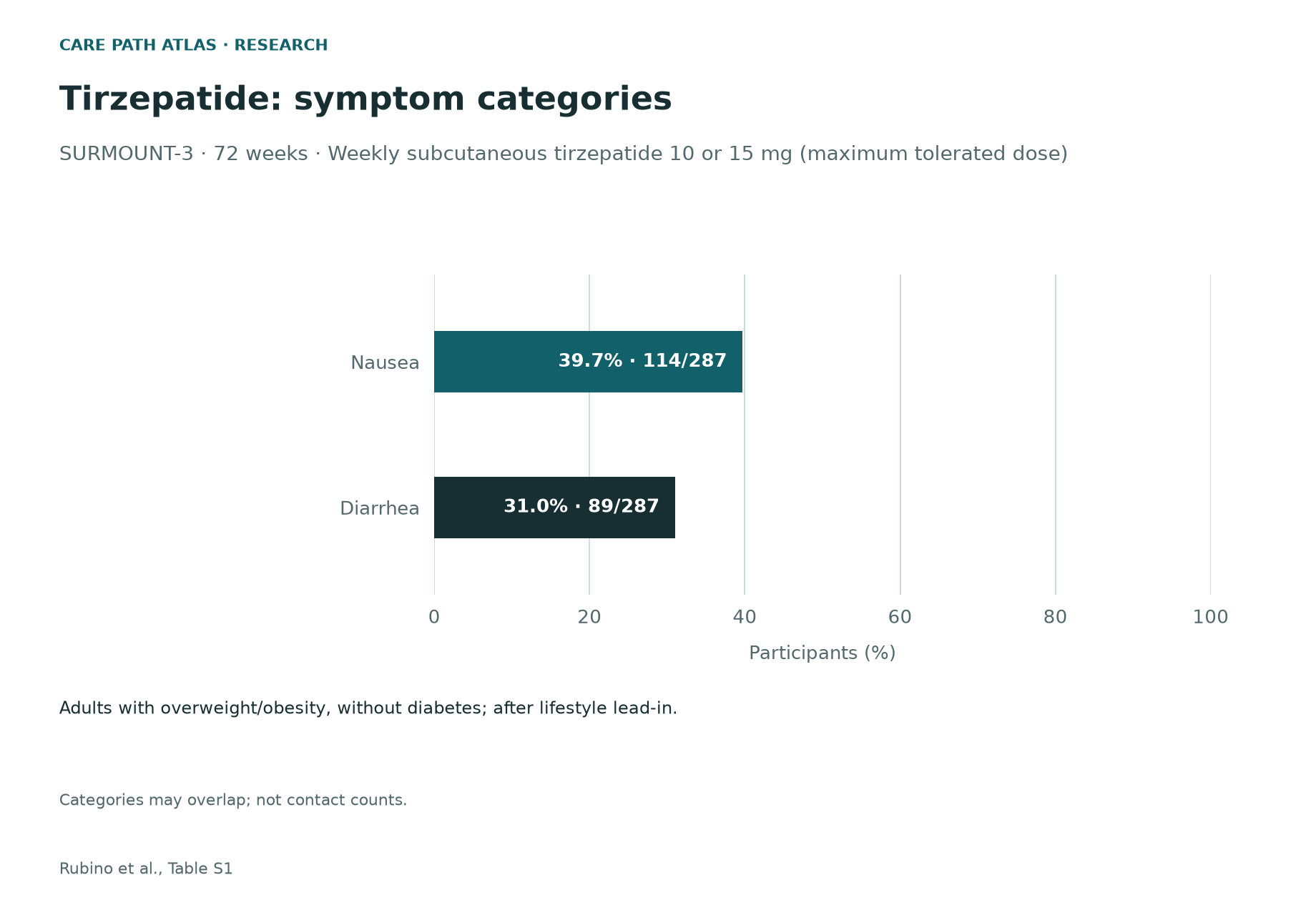
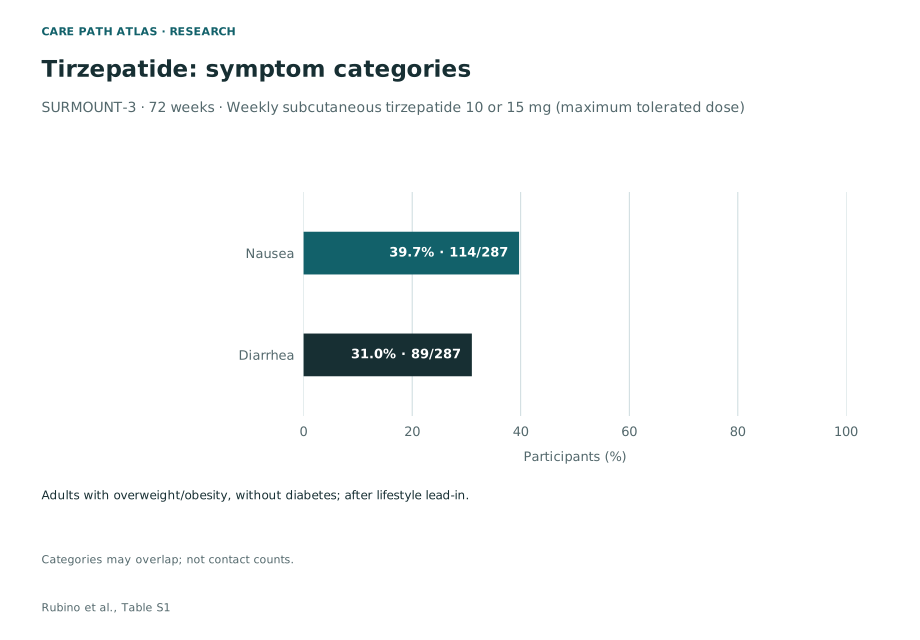
Tirzepatide: symptom categories
SURMOUNT-3 · 72 weeks · Weekly subcutaneous tirzepatide 10 or 15 mg (maximum tolerated dose)
Categories may overlap; not contact counts.
Sources: Rubino 2025
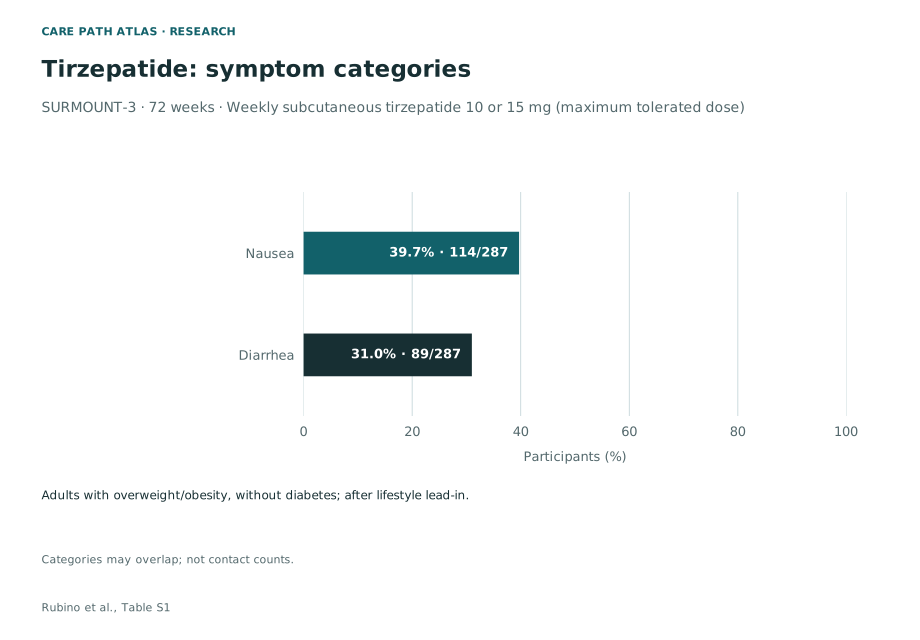
Adults with overweight/obesity, without diabetes; after lifestyle lead-in.
| Category | n/N | Percent |
|---|---|---|
| Nausea | 114/287 | 39.7% |
| Diarrhea | 89/287 | 31.0% |
Start with the question encoded in the table
Rubino et al. analysed reports post hoc; one event sufficed for symptom-group membership. Eli Lilly funded the study; six authors were employees and shareholders.
For interpretation, first write the question that a displayed value could answer. Identify the outcome, the group being described, and the observation boundary. This exercise prevents a familiar mistake: seeing a recognizable symptom name and silently supplying a much broader question about everyday experience. The figure’s accompanying definitions belong to the result. Removing them changes the meaning even when the displayed number remains identical.
Next separate the reported finding from the question you wish the evidence had answered. A reader interested in whether someone received useful follow-up needs records of communication and subsequent assessment. A table organized around symptom categories is not automatically organized around that service question. The missing connection requires additional evidence; it cannot be supplied by choosing a more reassuring interpretation of the same bar.
This is also why a disclosure about authorship and funding belongs in a careful reading. It identifies a documented relationship for readers to consider. It does not, by itself, prove that a particular entry is wrong or that an unreported service outcome occurred. Those conclusions would each need their own support.
Sources: Rubino 2025
Overlapping categories do not create a unique headcount
A category total is a margin: it describes one column without showing how that column intersects another. If the same identifier can appear in both columns, adding the margins counts some identifiers twice. The information needed to correct that sum is the shared membership. An attractive chart cannot reveal it merely by putting its bars beside each other.
Consider an invented equipment inspection, unrelated to clinical data. Four devices have scratches and three have dents. If no device has both defects, seven devices are affected. If all three dented devices are among the scratched devices, only four are affected. The category totals are unchanged. What changes is their intersection, which a list of category totals has not specified.
Applied to the figure, this reasoning tells us what calculation to withhold. Do not turn the sum of its categories into the proportion with either experience. Nor does a larger category establish that it contains every member of the smaller category. A linked cross-tabulation would answer that question. For broader context, our guide to comparing care routes can help keep documentary service questions separate from this statistical one.
Sources: Rubino 2025
Keep people, episodes, and messages in separate columns
An information system can describe the same underlying history in several ways. One row might stand for a person, an occurrence, a category assignment, or a communication. Before comparing totals, establish which kind of row is being counted. A large message total might reflect repeated discussion of the same unresolved issue; a small category total might compress a much richer history. Neither interpretation follows from size alone.
This distinction matters especially when a heading uses a broad term such as report or event. Preserve the author’s stated unit and examine the denominator rather than silently translating the heading into appointments, recurring episodes, or unique individuals. Where the wording leaves an ambiguity, the responsible reading retains that ambiguity. Numerical precision does not resolve a definition that the available record has not settled.
The teaching table below describes what additional evidence would distinguish these units. It is an editorial framework, not a reconstruction of participant records. A useful audit trail lets a reviewer move from a summary back to the definition of an entry. Without that connection, two databases can disagree simply because they count different objects, even when both accurately retain the information they were designed to store.
| Unit under discussion | Information needed | Inference to withhold |
|---|---|---|
| Person | A consistent person identifier and inclusion rule | One entry represents one occurrence |
| Episode | An occurrence definition and rules for separating recurrences | Each later message begins a new episode |
| Category | A classification rule and permission for multiple labels | Categories divide people into exclusive groups |
| Message | A communication identifier and links to the issue discussed | Receipt proves assessment or resolution |
Sources: Rubino 2025
A category summary cannot reconstruct a timeline
A timeline contains order as well as membership. Knowing that an identifier has two labels does not establish which label came first, whether the experiences overlapped, or whether a gap separated them. Different histories can map to the same final classification. This is a many-to-one transformation: the summary keeps a defined feature while discarding other features that are irrelevant to its immediate counting task.
Dates also need meanings. An occurrence date refers to the experience itself; an entry date refers to when information entered a record. A later correction might change either. Treating all three as interchangeable can produce an apparently tidy chronology that no longer represents what was actually known at each point. An unknown onset date should stay unknown instead of quietly becoming the date somebody typed a note.
To study duration, a researcher would need suitable start and end information and a rule for histories that remain unfinished. To study response time, the required boundaries would describe a communication process instead. Our companion semaglutide guide to observation clocks develops the time-origin problem. Comparing the questions is useful; importing one study’s timeline or results into another is not.
Sources: Rubino 2025
Missing detail is a separate state from an absent problem
A blank field has several possible meanings: the question was not asked, the answer was not recorded, the information was unavailable, or the field did not apply. Those possibilities should not collapse into a single negative value. Otherwise, the process of collecting information can create an apparent difference that a reader mistakenly attributes to the underlying experience.
Severity, seriousness, recurrence, and resolution also ask different questions. A category label alone does not assign values to all of them. The same logic applies to the phrase no further report: an absence of later documentation is not, without an appropriate definition and observation process, proof that the earlier concern ended. A careful analysis distinguishes a recorded negative answer from an unanswered question.
This is a measurement issue before it is a statistical issue. More decimal places cannot repair a field whose meaning varies across records. A reviewer needs to understand the allowed values, how missing information was represented, and whether the same definition was used throughout. Those are questions to investigate, not assumptions about the study’s procedures. In preparing an online intake, the corresponding documentary task is to make uncertainty visible rather than filling gaps with guesses.
Sources: Rubino 2025
Match the statistical comparison to its purpose
There are two different comparisons a reader might attempt: compare two categories within a group, or compare the same category across groups. They require different data structures. The first asks how outcomes differ within the selected set of records; the second asks how an outcome differs between sets. Substituting one for the other changes both the question and the interpretation.
For a within-group comparison, shared membership matters to uncertainty as well as to counting. Two labels attached to some of the same identifiers are not automatically independent observations. The joint pattern can affect how a difference should be assessed. Category totals alone therefore cannot justify inventing a confidence interval, a significance test, or a claim that the relative lengths demonstrate a treatment effect.
A statistical annotation must remain attached to its documented comparison. Moving it beside a different pair of bars does not transfer its meaning. Readers can audit a claim by naming the two quantities actually compared, the outcome definition they share, and the population they represent. If those elements are absent, a statement of superiority is getting ahead of the evidence. A clear descriptive chart can remain useful without making that additional claim.
Sources: Rubino 2025
A denominator describes a cohort with boundaries
The denominator is the set of records eligible to contribute to a calculation. Its definition can incorporate entry criteria, earlier participation, the beginning of an observation period, or the availability of particular measurements. Saying who is inside that set is part of the scientific result. It is not a decorative detail to remove when adapting a finding for another audience.
Selection and comparison are related but distinct questions. A well-defined comparison within a selected cohort does not establish that the cohort represents everyone who might ask about treatment. Conversely, the existence of selection does not automatically invalidate an analysis for the population it actually describes. The task is to preserve the question’s scope, then identify which additional assumptions a broader application would need.
The figure’s population and treatment-period notes provide the boundaries for reading its displayed values. They do not identify the experience of an unnamed future applicant or establish local availability. When requesting a clinic appointment, use current service documents to clarify access. That practical inquiry complements the research question; it is not a way to obtain an individual forecast from the study denominator.
Sources: Rubino 2025
Preserve meaning when records are linked or corrected
Record linkage means deciding which entries refer to the same underlying person, issue, or occurrence. Good linkage requires more than matching similar wording. Two messages can repeat one concern, while two similar descriptions can refer to distinct occurrences. A rule that merges everything sounding alike may erase recurrence; a rule that never merges anything may manufacture duplication.
An auditable record preserves the original entry and makes a later correction traceable. Overwriting an uncertain date with a confident-looking replacement can conceal why the interpretation changed. Keeping provenance—the source and history of information—allows a later reviewer to distinguish the original account from subsequent clarification. This is an original methodological framework, not a claim about how any particular trial or provider operated.
The table separates useful evidence states so that a handoff does not silently skip one. A record can be received without its meaning being settled, and a question can be acknowledged while remaining unresolved. Each transition needs its own evidence. For the practical context, the guide to switching providers offers a place to organize the documentary questions; this framework does not establish that a transfer has occurred.
| Evidence state | Record that would support it | Question still open |
|---|---|---|
| Information entered | Original wording, source, and date meaning | Does it duplicate or supplement another entry? |
| Information corrected | A linked correction with its reason | Which conclusions depend on the earlier version? |
| Information received | Acknowledgment identifying the material received | Has the clinical question been assessed? |
| Responsibility assigned | A documented owner and unresolved question | What evidence will show that the next step occurred? |
Sources: Rubino 2025
Turn measurement questions into a clear care handoff
Our editorial application is to ask for a process that can be described in records. What information should be sent? Who confirms receipt? Who is responsible for an unresolved clinical question? Where are the written instructions for contact outside routine hours? These are questions for the care team, not findings about the services listed in the directory.
A person comparing services can keep administrative and clinical questions separately identified. A payment acknowledgment answers a payment question. A message acknowledgment establishes that a message reached a destination. Neither should acquire the meaning of a clinical assessment simply because it appears in the same portal. The whole-service comparison guide provides related documentary context.
For a specific record to investigate, the SuperHealthy Rx review links readers to published descriptions to check. This reference does not establish availability, the studied treatment, or a response commitment. The scientific contribution is the discipline of matching each conclusion to the record that could actually support it.
Sources: Rubino 2025
Keep prescribing information separate from a counting framework
Zepbound is contraindicated with personal or family medullary thyroid carcinoma, MEN2, or serious hypersensitivity to tirzepatide or its ingredients. Its boxed warning concerns rodent thyroid tumors; human relevance is unknown. Warnings include pancreatitis, gallbladder disease, dehydration-related kidney injury and severe gastrointestinal reactions. It is not recommended with severe gastroparesis. Seek prompt assessment for severe or persistent abdominal pain; contact a clinician for severe or persistent gastrointestinal symptoms. Tell the care team about treatment before anesthesia. Research categories cannot determine personal treatment changes.
The methodological framework above concerns how to read evidence and preserve the meaning of information. It is not a symptom-triage system. A category summary cannot decide whether a particular experience is urgent, whether treatment should change, or whether another explanation needs investigation. Those questions require an appropriate clinical assessment rather than a comparison with the length of a bar.
Use the research figure to ask a better question about measurement. Use current prescribing information and the care team’s instructions for the separate safety discussion. Keeping these purposes explicit prevents a polished worksheet from taking on authority it does not have. The useful output is a clearer record and a clearer unresolved question, not an independently chosen regimen.
Sources: Zepbound label; Rubino 2025
Questions about the evidence
Why not add the two categories?
Addition counts category memberships. A unique headcount requires knowing which memberships belong to the same identifiers. Without that intersection, the sum answers a different question. The appropriate response is to leave the combined headcount unresolved, not to select an overlap assumption because it produces a convenient result.
Sources: Rubino 2025
Does a repeated message establish a repeated episode?
No. Repetition could reflect a follow-up question, a correction, or another occurrence. Distinguishing those possibilities requires a definition and links between records. The message itself is evidence of a communication; its relationship to an episode has to be established separately rather than inferred from how many times similar wording appears.
Sources: Rubino 2025
Can a report date stand in for an unknown onset date?
Only if the analysis explicitly defines and justifies that substitution for its particular question. It should not happen silently. Preserving both the date that is known and the uncertainty about the missing date makes the limitation visible and prevents an apparent timeline from becoming more precise than the underlying information.
Sources: Rubino 2025
Does the longer bar prove a treatment is less tolerable?
A descriptive difference between outcome categories does not by itself compare treatments. First identify the groups, the shared outcome, and the relevant observation boundaries. A treatment-comparison claim needs evidence for that comparison and its uncertainty. Relabeling a within-group contrast cannot provide the missing comparison.
Sources: Rubino 2025
What would show that a clinical question reached its next step?
Look for a record appropriate to the claimed step: receipt, assessment, responsibility, or a subsequent action. These are distinct evidence states. Asking who owns an unresolved question can clarify a handoff, but the question alone does not prove that a provider has accepted responsibility or completed a clinical review.
Sources: Rubino 2025
Editorial assessment
The strongest reading of a symptom table preserves its definitions while resisting the urge to supply an unseen history. Start with the unit and denominator, keep shared membership unresolved when necessary, and identify which dates or linked records would answer the next question. Those habits make both statistical interpretation and care documentation more precise. For Care Path Atlas, the practical value is a better-informed conversation about the information that must travel with a person’s questions. A study summary can support that conversation without becoming a score for a provider, a prediction of responsiveness, or a substitute for clinical assessment.
Sources and access
- Gastrointestinal tolerability of once-weekly semaglutide 2.4 mg in adults with overweight or obesity, and the relationship between gastrointestinal adverse events and weight loss.
Full article and supplementary Table S2 checked.
Checked 2026-10-26.
- Gastrointestinal tolerability and weight reduction associated with tirzepatide in adults with obesity or overweight with and without type 2 diabetes in the SURMOUNT-1 to -4 trials.
Full article and supplementary Table S1 checked.
Checked 2026-10-26.
- DailyMed: WEGOVY semaglutide current prescribing information
Current official prescribing information checked.
Checked 2026-10-26.
- DailyMed: ZEPBOUND tirzepatide current prescribing information
Current official prescribing information checked.
Checked 2026-10-26.